This section of the A4 is served by the X39 bus, a fast and frequent service running between Bath and Bristol that does not stop in central Keynsham. Our aim is to connect Keynsham to the X39 service to provide new, reliable journey options for journeys to Bristol and Bath.
We are also proposing a new shared use path along the whole length of the Keynsham Bypass for walking, wheeling and cycling, creating a direct link between Bath and Bristol. Connections to this path from Keynsham would be provided at Memorial Park and Gaston Avenue.
Based on previous feedback, we have designed these proposals to maintain the same number of lanes of traffic along most of the bypass, avoid new bus lanes as far as possible, and minimise construction and environmental impacts, such as loss of trees.
We are proposing two new bus stops on the Keynsham Bypass – one on each side of the road – that would provide access to the X39 bus to Bath and Bristol. These bus stops would mean access to up to four more buses per hour to Bath and Bristol city centres, and would be accessed via short sections of new path in Memorial Park and at the western end of Gaston Avenue.
We considered potential locations for these bus stops and how people could get to them. The location on the bypass is more central to Keynsham, enables the creation of the shared use path, and needs less significant engineering, earthworks and tree removal. Other options considered included Station Road, The Avenue and Pool Barton.
To ensure buses can stop safely and continue their journeys smoothly after stopping, there would be short sections of bus lane on either side of the stops. This means that for 200 metres, including the bus stop itself, other vehicle traffic would merge into one lane on the bypass. This bus lane would be enforced with traffic cameras.
We would create two new, accessible, signalised crossings to help people safely reach the bus stops. These crossings would provide access between the shared use path and the northern side of the carriageway, with a waiting area between them on the central reservation.
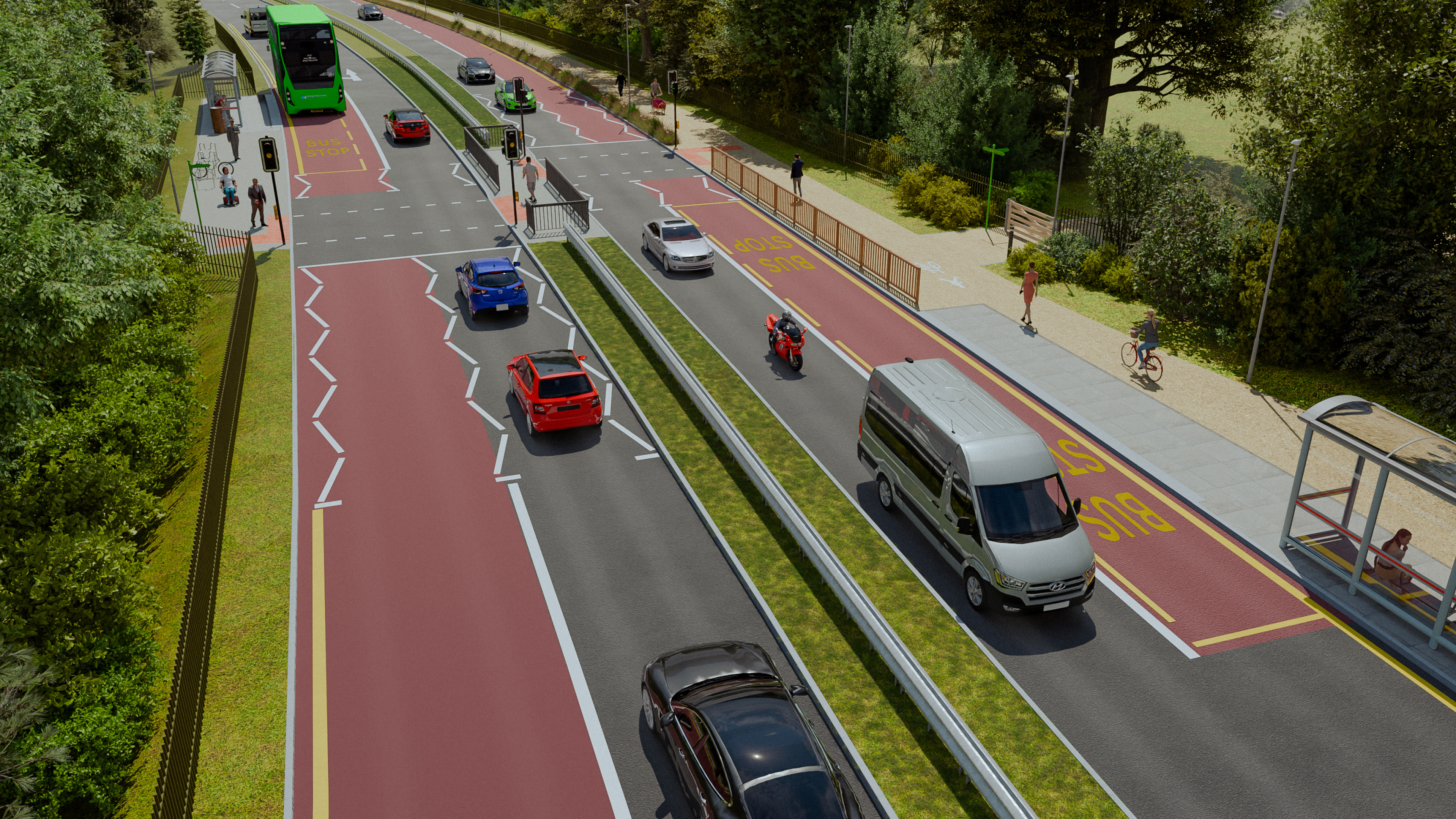
View of the new bus stops and path on the bypass. Click image to enlarge.
Click here to view our interactive map and see how these new stops link into Keynsham and the bypass
We are proposing a new four metre wide path, 70 metres in length, to connect the existing access on The Park road to the bus stops and shared use path.
The current access gate at The Park (which joins Station Road) would be improved, and a new secure gate would be installed where the access path meets the bypass. We are exploring the potential for minimal lighting along the path.
The new secure gate from the bypass would be designed to balance safety and accessibility to the park, minimising visual impact, while maintaining safety through fences and a gated access to the A4. This gate has been designed to be as accessible and inclusive as possible, with people using mobility equipment in mind.
We have carefully aligned the new route to minimise the impacts on trees, and the gradient would be adjusted to maximise accessibility. We anticipate having to remove approximately 10 trees between the existing route and the bypass. Any trees that need to be removed would be relocated or replaced nearby, in line with local planning policy. We have developed a landscaping plan for how to do this sensitively.
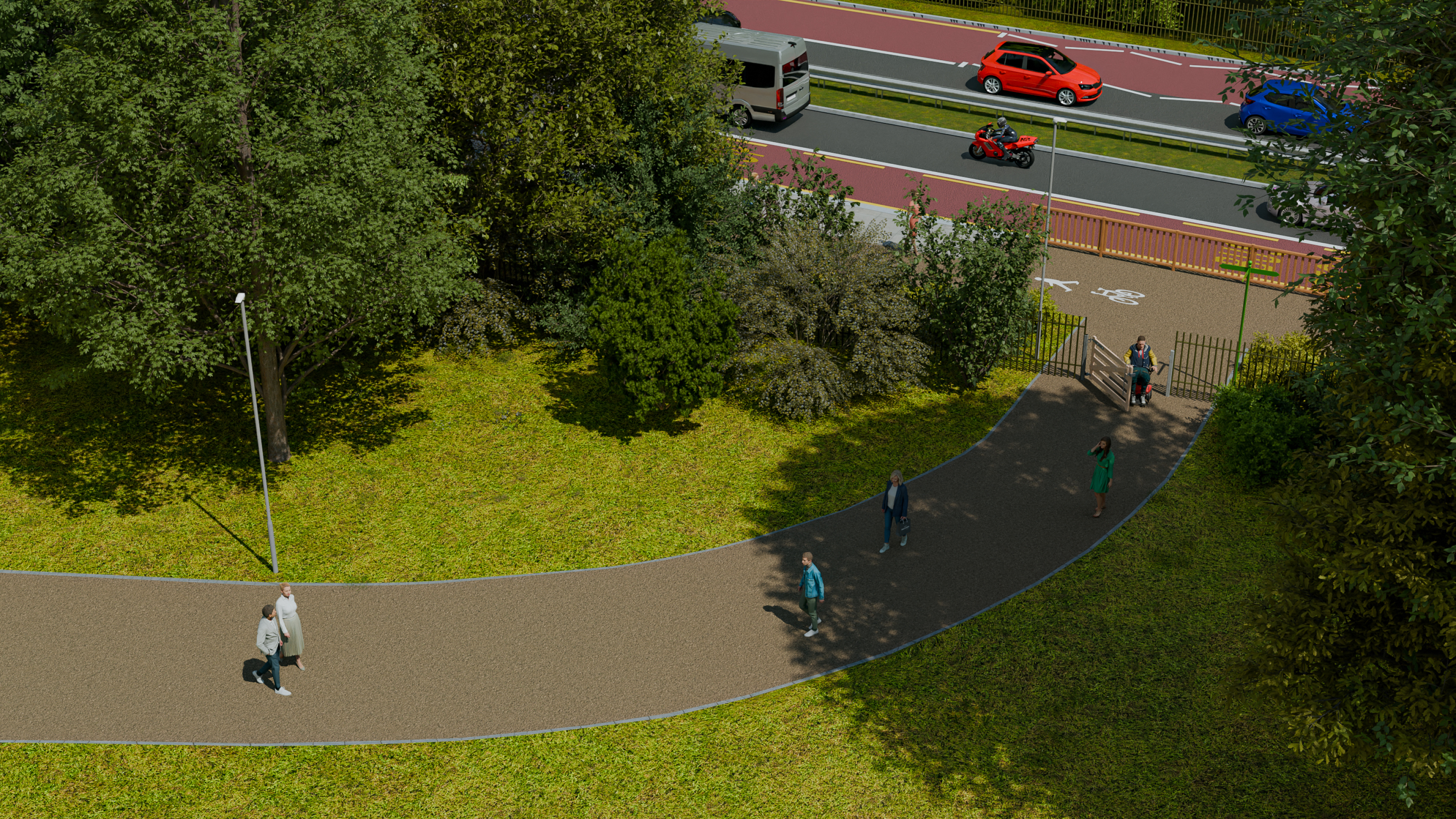
View of the bypass from Memorial Park. Click image to enlarge.
We are proposing over two miles (3.45 kilometres) of new shared use path to run alongside the south side of the Keynsham Bypass, connecting the existing path in Bristol to Broadmead roundabout and Keynsham. This would provide the people of Keynsham with a direct, safe way to more easily cycle, wheel or walk to or from Bristol or towards Bath. There would be a space between the new path and the road, landscaped with plants wherever possible to make it safer and more pleasant to use.
Most of the new path would have new lighting, which can help increase cycling by helping people feel safer, including women and other users who may be less likely to use unlit routes.
The lighting would be angled to face the path instead of the road and is specifically designed to reduce glare for drivers. We decided not to add lighting to the entire Keynsham Bypass to minimise any environmental and wildlife impacts, as well as provide better value for money.
To accommodate the width of the shared use path, we would need to make minor changes to how the bypass is laid out on the south (Bristol-bound) side only. This would involve slightly narrowing the traffic lanes and reducing the width of the central reservation. Apart from the 200 metres of bus lanes to serve the new bus stops, there would still be two lanes of traffic running in each direction along the length of the bypass.
Our proposals aim to strike the right balance between the needs of all road and path users. We have listened to feedback from previous consultations and are not proposing a 24-hour bus lane on the bypass. However, to deliver the benefits that the new shared use path and bus stops would bring, we need to reduce the speed limit to 40 mph (30 mph on Hicks Gate roundabout).
National design standards for cycling, walking and wheeling paths determine how people using the path need to be protected from traffic. Depending on a road’s speed limit, a buffer might be needed between road and path; the higher the speed limit, the wider the buffer needs to be. The bypass speed reduction is therefore needed, otherwise the higher traffic speeds would mean a wider buffer is needed, making it harder to keep the same number of traffic lanes on the bypass.
So, to safely implement the shared use path, the crossings on the bypass and keep two lanes on the A4, the maximum speed limit for the road needs to be 40mph. The speed limit will be enforced by average speed cameras at either end of the bypass. This speed limit is also more consistent with that on either side of the bypass, currently 40mph towards Bristol or 30mph towards Bath through Saltford.
In addition to Memorial Park, we are proposing another access point to the new bypass bus stops and shared use path from Gaston Avenue, to provide cycle access and boost connectivity with the east of Keynsham. This access has been designed to minimise the impact on the existing hedgerow, and would be for walking, wheeling and cycling only, not cars or other motor vehicles.
A bollard would be installed at the Gaston Avenue end to prevent cars from entering. Fencing would be added where the route joins the bypass to help improve safety.
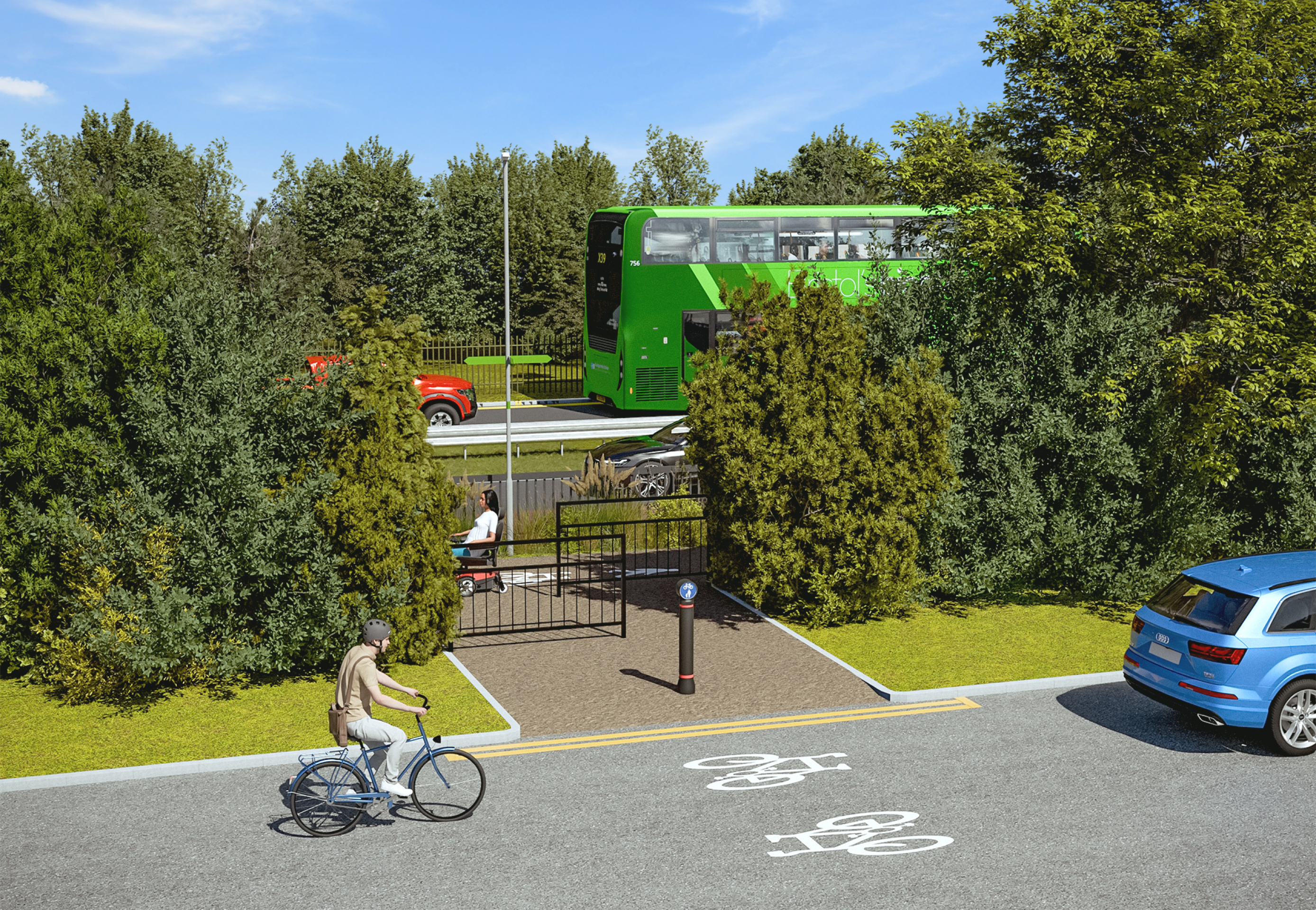
Gaston Avenue access point. Click image to enlarge.
A new crossing would be installed 60 metres to the south of Hicks Gate roundabout, on the A4175. This would help walkers, wheelers and cyclists get around the roundabout, and its location has been chosen to avoid needing to make substantial changes to the roundabout itself, minimising construction impacts and reducing overall project cost.
The roundabout’s speed limit would be reduced from 40 mph to 30 mph to accommodate the new crossings. Vehicles will already be expected to be travelling at this speed or lower to turn on the roundabout.
We are also making minor changes to the eastern approach to Hicks Gate by reconfiguring the lane allocation to improve the right turn movements to the A4174. Currently, the third lane is marked for straight ahead movements (continuing on the A4). We propose to change the lane allocation to a straight ahead and right turn lane (to the A4 or right to the A4147). This is expected to improve traffic operation on the roundabout for motorists headed towards Bristol and Longwell Green at busy times..
The existing crossing on the west side of the roundabout would be improved through widening the waiting area in the central reservation to five metres. This would make it more accessible to pedestrians and users of adapted/non-standard cycles (such as hand-cycles or trikes), as well as other specialised vehicles such as cargo bikes or trikes. It would also provide a new link to National Cycle Network Route 416, enabling onward connections to Longwell Green and the A4174 ring road. The proposals would tie-in to the existing shared use paths in this area, which we hope will encourage more cycling, walking and wheeling journeys.
What would these changes mean?
- Better access to buses and safe active travel for people travelling to schools, work, and shops in and around Keynsham
- Access to the X39 bus from the centre of Keynsham, meaning up to four more buses per hour for Keynsham residents to get to Bath and Bristol city centres
- New shared use path to facilitate active travel between Hicks Gate roundabout and Broadmead roundabout, providing a direct for cyclists, walkers and wheelers between Keynsham, Bath, and Bristol
- Safer crossings at Hicks Gate roundabout
What’s changed since 2023?
- We are no longer proposing bus lanes along the full length of the Keynsham Bypass
- We are no longer proposing a mobility hub in Memorial Park
- With the exception of 200 metres in either direction near the new bus stops, we are retaining two traffic lanes in both directions along the Keynsham Bypass
- With the exception of one new bus stop on the north side, we only propose to do works on the south side of the bypass, minimising tree loss and construction impacts
- Improved accessibility through the new shared use path and crossings